
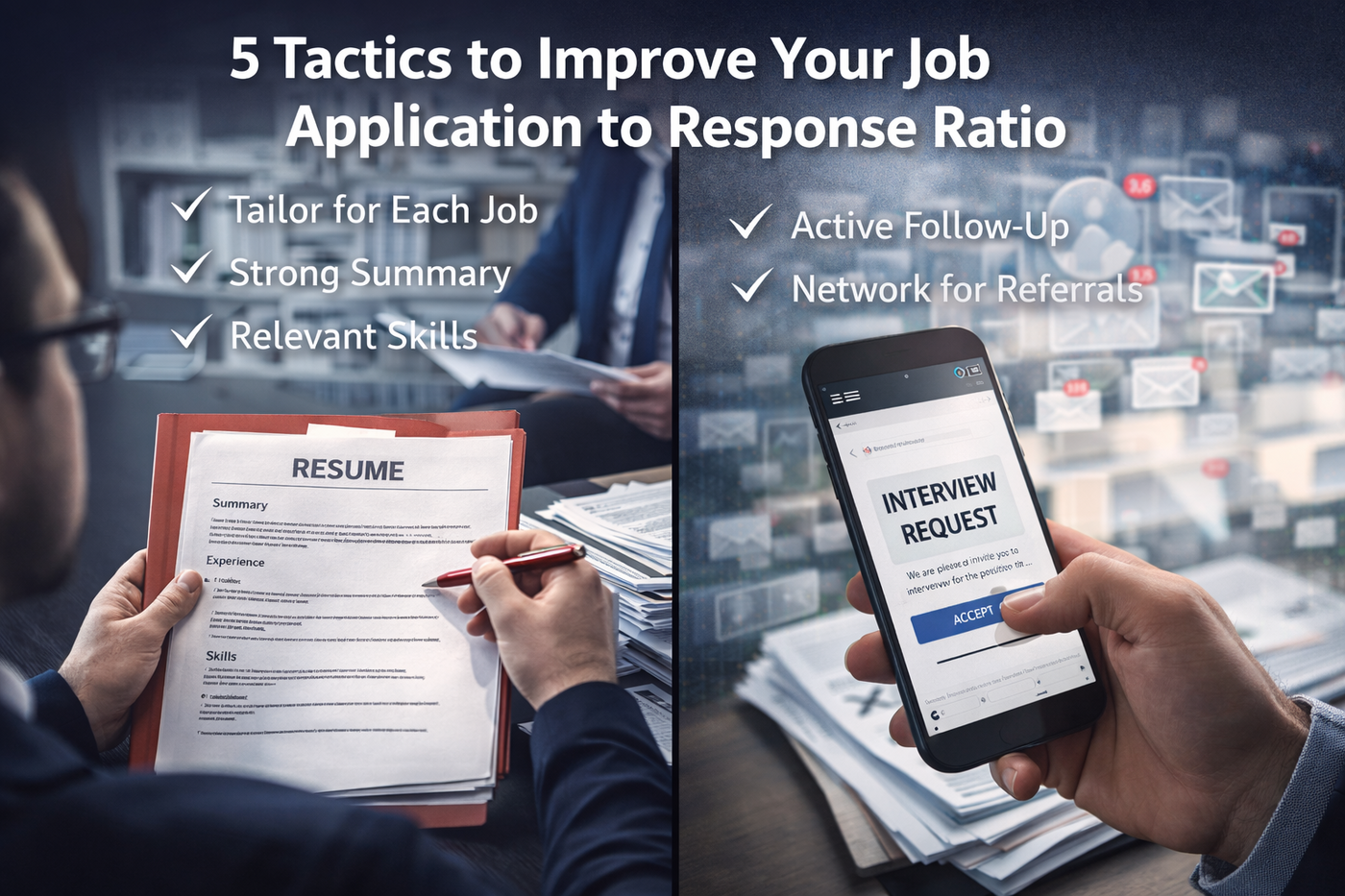
5 Tactics to Improve Your Job Application to Response Ratio in 2026
Black Tech Jobs I Executive Talent Insights
Most job seekers focus on volume.
They apply to 50 roles, then 100, then 200, assuming the math will eventually work in their favor.
But response rate is not a volume problem. It is a signal problem.
If you are not receiving interview requests, something in your application process is not aligning with how hiring systems and hiring managers evaluate candidates.
Below are five structural adjustments that consistently improve the application-to-interview ratio.
1. Optimize for Applicant Tracking Systems Without Writing for Robots
Roughly 70 to 80 percent of large employers use an Applicant Tracking System, or ATS, to screen resumes before a human ever sees them. Many resumes are filtered out at this stage.
An ATS does not “judge” quality. It parses structured information:
- Job titles
- Skills
- Certifications
- Education
- Keywords aligned with the job description
If your resume does not clearly map to the language of the role, it may never reach a recruiter.
Improvement strategy:
- Use the exact terminology from the job description where accurate.
- Match required skills explicitly in a skills section.
- Avoid complex graphics or formatting that may confuse parsing software.
- Include clear, standard section headings such as Experience, Education, Certifications, and Skills.
The goal is not keyword stuffing. It is clarity. If your resume reflects what the job description is asking for, the system will pass it forward.
2. Tailor Each Resume to the Role, Not the Industry
One of the most common mistakes job seekers make is sending the same resume to every opening.
Hiring managers are not asking, “Is this person generally capable?”
They are asking, “Can this person solve the problems in this specific role?”
Tailoring does not mean rewriting your entire resume every time. It means adjusting emphasis:
- Reordering bullet points to prioritize the most relevant experience.
- Aligning phrasing with the company’s terminology.
- Highlighting metrics that directly relate to the job’s responsibilities.
- Removing or minimizing unrelated accomplishments.
The average response rate for online applications is often cited between 10 percent and 30 percent depending on role and seniority. If you are below that range, customization is usually the first lever to pull.
Tailored resumes communicate intent. Intent increases response probability.
3. Leverage Referrals and Strategic Networking
Multiple labor market studies consistently show that referrals remain one of the strongest predictors of interview conversion.
Professional networking platforms report that a large percentage of hires involve some level of referral or internal introduction.
This does not mean you must “know someone at every company.”
It means you must:
- Activate your existing network.
- Ask for introductions.
- Reconnect with former colleagues.
- Engage meaningfully on professional platforms.
- Attend industry events with a clear follow-up plan.
The key insight is this: hiring managers trust signal validation. A referral acts as credibility acceleration. It moves you from “unknown applicant” to “recommended candidate.”
Networking is not transactional. It is relational. Build relationships before you need them.
4. Follow Up Professionally and Strategically
Many applicants assume that submitting a resume completes their responsibility.
In reality, thoughtful follow-up often differentiates candidates.
A concise follow-up message can:
- Reinforce your interest.
- Highlight a specific value proposition.
- Keep your name top of mind.
- Demonstrate professionalism.
A simple framework:
Subject: Following Up on [Position Title] Application
Dear [Hiring Manager’s Name],
I wanted to reiterate my strong interest in the [Position Title] role. My experience in [specific skill or accomplishment] aligns closely with your team’s goals, and I would welcome the opportunity to contribute. Please let me know if there is any additional information I can provide.
Best regards,
[Your Name]
Keep it brief. Keep it specific. Avoid sounding entitled or impatient.
Follow-up is not pressure. It is professional persistence.
5. Remove Irrelevant Information and Strengthen Relevance Signals
A resume is not a biography. It is a targeted marketing document.
Including irrelevant information weakens your positioning. It signals lack of focus.
Hiring managers scan quickly. They are looking for:
- Direct role alignment
- Quantifiable impact
- Clear progression
- Evidence of capability
If your resume includes outdated technologies, unrelated roles, or excessive detail that does not connect to the position, you dilute your strongest qualifications.
Before submitting, ask:
- Does every bullet point support my candidacy for this specific role?
- Are my most relevant achievements visible within the first half page?
- Have I demonstrated measurable outcomes?
Clarity increases confidence. Confidence increases response rates.
Final Perspective
Improving your job application-to-response ratio is not about gaming the system.
It is about understanding how the system evaluates candidates.
When you:
- Align with ATS structures,
- Tailor intentionally,
- Activate your network,
- Follow up professionally,
- And remove irrelevant noise,
you shift from passive applicant to strategic candidate.
The job market rewards signal clarity.
Focus less on how many applications you send.
Focus more on how clearly each one communicates your value.
FAQ: Improving Your Job Application Response Rate
What is a good job application-to-interview ratio?
For most professional roles, a healthy response rate typically falls between 10 percent and 30 percent, depending on industry, seniority, and market conditions.
Early-career candidates applying broadly may see lower response rates. Mid-career and senior professionals who apply strategically and leverage referrals often see significantly higher response ratios.
If your response rate falls consistently below 10 percent, it usually signals misalignment in one of three areas:
- Resume positioning
- Role targeting
- Network activation
Response rate is a diagnostic tool. It reflects signal clarity, not just competition.
How can I improve my ATS score?
Improving your ATS performance is less about scoring higher and more about structural alignment.
To improve ATS pass-through rates:
- Match your resume language directly to the job description.
- Include required certifications, tools, and skills exactly as listed.
- Use standard formatting with clear section headers.
- Avoid images, columns, or excessive graphics.
Applicant Tracking Systems are designed to filter based on relevance. Clear alignment increases the likelihood your resume is forwarded to a human reviewer.
Does networking really improve interview chances?
Yes. Referrals significantly increase interview probability.
Hiring managers use referrals as credibility accelerators. A referral reduces uncertainty because it introduces social proof.
Strategic networking does not mean asking strangers for favors. It means:
- Re-engaging former colleagues.
- Requesting warm introductions.
- Contributing value in professional communities.
- Maintaining consistent professional visibility.
Many roles are filled before they reach late-stage application review. Networking positions you earlier in the decision cycle.
Should I follow up after submitting a job application?
A professional follow-up can increase visibility and demonstrate initiative.
Follow up when:
- You have applied to a high-priority role.
- You have a direct contact within the organization.
- You can reinforce a specific value proposition.
Avoid repetitive or aggressive messaging. One concise follow-up after five to seven business days is appropriate in most cases.
Why am I applying to many jobs but getting no interviews?
This pattern often reflects one or more structural issues:
- Submitting identical resumes to different roles.
- Targeting roles above or outside demonstrated scope.
- Including irrelevant experience that dilutes positioning.
- Failing to activate referral pathways.
- Not aligning keywords with job descriptions.
If volume increases but interviews do not, the issue is rarely effort. It is usually positioning.
