
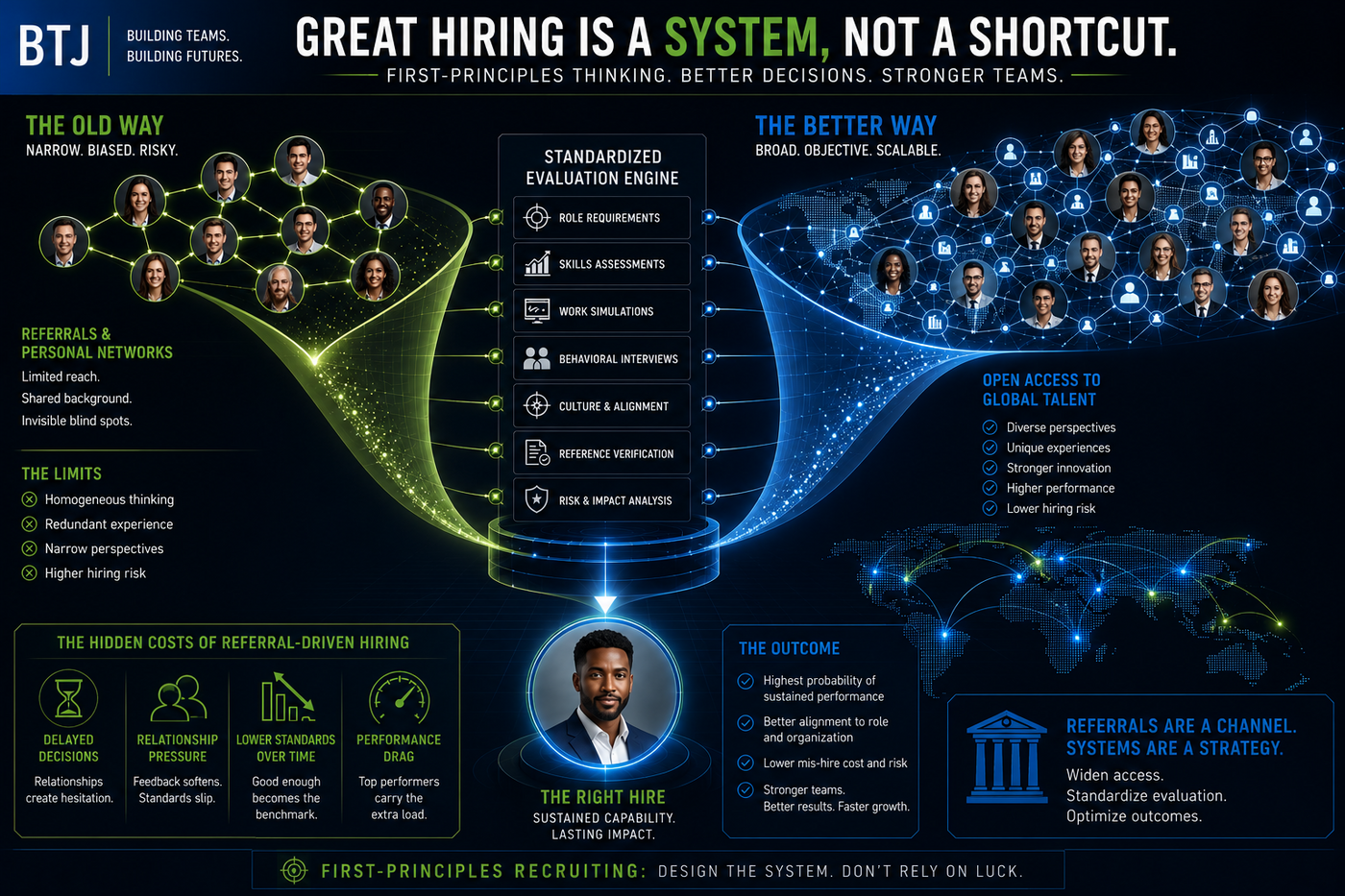
First Principles Recruiting: Why Employee Referrals Break at Scale
BTJ I Executive Talent Insights
At its core, recruiting is not a social exercise, a cultural ritual, or even a branding function. When stripped down to first principles, hiring resolves into a single objective: securing the highest probability of sustained capability and alignment for a specific role at a predictable cost. Every method of sourcing and selecting talent must ultimately be evaluated against that objective.
Employee referrals—and more specifically, the broader “friends and family” hiring model—appear, at first glance, to perform exceptionally well. They offer speed, trust, and low friction. For early-stage organizations, these benefits can be decisive. But when examined through a first-principles lens, the model reveals structural weaknesses that become increasingly costly as organizations scale.
Three foundational breakdowns emerge: constrained talent pool math, compromised evaluation objectivity, and distorted risk management dynamics.
The Math of the Talent Pool
The first principle of talent acquisition is probabilistic: to maximize the likelihood of identifying high-performing individuals, you must source from the widest viable pool of qualified candidates. Talent—especially elite technical or leadership talent—is not evenly distributed, nor is it conveniently clustered within personal networks.
Employee referrals violate this principle by definition. A personal network is a statistical anomaly shaped by geography, industry exposure, education, and socio-economic background. Even in highly connected professional circles, the network remains narrow relative to the global talent market.
When organizations over-index on referrals, they implicitly assume that the optimal candidate for a role—whether that is scaling AI infrastructure, leading regulatory compliance, or managing complex healthcare systems—exists within one or two degrees of separation from existing employees. From a probabilistic standpoint, this assumption collapses quickly.
The issue compounds at scale. As hiring volume increases, the marginal value of each additional referral decreases. The same network begins to recycle similar profiles, reinforcing homogeneity in thinking, experience, and problem-solving approaches. This is not just a diversity issue—it is a performance issue. Homogeneous teams are more prone to blind spots, slower adaptation, and correlated failure modes.
In contrast, first-principles recruiting demands systematic expansion: leveraging multiple sourcing channels, global reach, and data-driven targeting to ensure that the candidate pool reflects the full distribution of available talent.
The Mechanics of Evaluation
The second principle of hiring is epistemological: decisions must be grounded in objective verification of capability, behavioral alignment, and demonstrated outcomes relative to the role’s requirements.
Referrals introduce a subtle but powerful distortion into this process. Human cognition is not neutral; it is shaped by affinity bias, social trust, and loss aversion. When a candidate is introduced through a personal or professional relationship, evaluators unconsciously substitute familiarity for evidence.
Trust, in this context, becomes a proxy for competence.
This substitution is particularly dangerous in complex or high-stakes roles. A referral may be perceived as “safe” because they are known, vouched for, or socially validated. But this perceived safety can mask gaps in technical skill, leadership ability, or execution discipline.
Even structured interview processes are not immune. Interviewers may ask softer questions, interpret ambiguous answers more favorably, or overweight anecdotal endorsements. Over time, this erodes the integrity of the evaluation system.
First-principles recruiting requires the opposite approach: standardized, role-specific assessment frameworks that minimize subjective variance. This includes work simulations, technical evaluations, and structured behavioral interviews tied directly to performance outcomes. The goal is not to eliminate trust, but to ensure that trust is earned through evidence rather than inherited through association.
The True Cost of Separation
The third principle is operational: organizations must be able to rapidly address underperformance to protect overall system efficiency. This includes coaching, reassignment, or termination when necessary.
Referrals fundamentally alter the cost structure of these decisions.
In a traditional hire, the cost of separation is primarily financial and operational—severance, backfilling, and temporary productivity loss. In a referral-based hire, an additional layer is introduced: relational cost. Terminating a referred employee can strain internal relationships, damage team cohesion, and, in the case of friends or family, create external social consequences.
This emotional and social cost leads to predictable behavior: delayed decision-making. Managers hesitate to address performance issues, extend timelines for improvement, or avoid difficult conversations altogether. What would be a straightforward performance management issue becomes entangled in interpersonal dynamics.
The result is a form of organizational drag. Underperforming individuals remain in roles longer than they should, reducing team effectiveness and increasing the burden on high performers. Over time, this erodes both culture and output.
From a first-principles perspective, this is a misalignment of incentives. The system should optimize for organizational health, but referral dynamics shift the optimization toward relationship preservation.
The Stage-Based Reality
It is important to recognize that referrals are not universally flawed. Their effectiveness is highly dependent on organizational stage.
At the earliest phase of a company—what might be called Stage 0—the primary constraint is not optimization but survival. There is no employer brand, limited capital, and minimal infrastructure. In this environment, the first principle is velocity: the ability to move quickly with high-trust individuals who are willing to operate under uncertainty.
Here, referrals and personal networks are not just useful—they are often necessary. The initial team of two to five people is less about perfect role fit and more about shared commitment, adaptability, and trust under pressure.
However, the transition from Stage 0 to Stage 1 marks a fundamental shift. As the organization begins to scale, the constraints change. The focus moves from survival to repeatability, from trust to performance, and from speed to system design.
At this point, the continued reliance on referrals becomes a liability. The same factors that once accelerated progress—tight networks, informal evaluation, relational trust—now hinder scalability, objectivity, and operational discipline.
A Systems View of Referrals
From a systems perspective, employee referrals should be treated as one input among many, not as a dominant strategy. They can be valuable for introducing candidates into the pipeline, particularly when combined with incentives that encourage thoughtful recommendations.
However, the downstream process must remain consistent. Referred candidates should undergo the same rigorous evaluation as any other applicant. Hiring decisions should be based on data and demonstrated capability, not on the strength of the referral.
Organizations that succeed at scale tend to decouple sourcing from selection. They allow referrals to expand the top of the funnel but rely on structured systems to govern the rest of the process.
Illustration: Two Hiring Models
Consider two companies hiring for a senior machine learning engineer.
Company A relies primarily on employee referrals. The candidate pool consists of individuals within existing networks. Interviews are partially structured, but referrals receive informal endorsements that influence decision-making. A hire is made quickly, but performance issues emerge after six months. Due to internal relationships, corrective action is delayed.
Company B uses a multi-channel sourcing strategy, including outbound recruiting, targeted job postings, and referrals as a supplemental channel. All candidates complete a standardized technical assessment and structured interviews. The process takes longer, but the selected candidate demonstrates strong alignment with role requirements and performs consistently over time.
The difference is not just in hiring speed—it is in long-term organizational efficiency.
