
Healthcare Informatics Trends Shaping 2026
BTJ Health I Executive Talent Insights
Healthcare informatics is entering a new phase in 2026. For much of the past two decades, the field was defined by digitizing health information, implementing electronic health records and connecting clinical systems. Today, healthcare informatics sits at the intersection of artificial intelligence, clinical workflows, data interoperability, cybersecurity and the broader digital transformation of healthcare.
The shift is changing what health systems need from their technology infrastructure and their people. The central challenge is no longer simply whether an organization can deploy another digital health application or launch an AI pilot. Healthcare leaders must determine whether they have the trusted clinical data, interoperable systems, governance, security and workforce capabilities required to move AI into everyday healthcare operations safely and at scale.
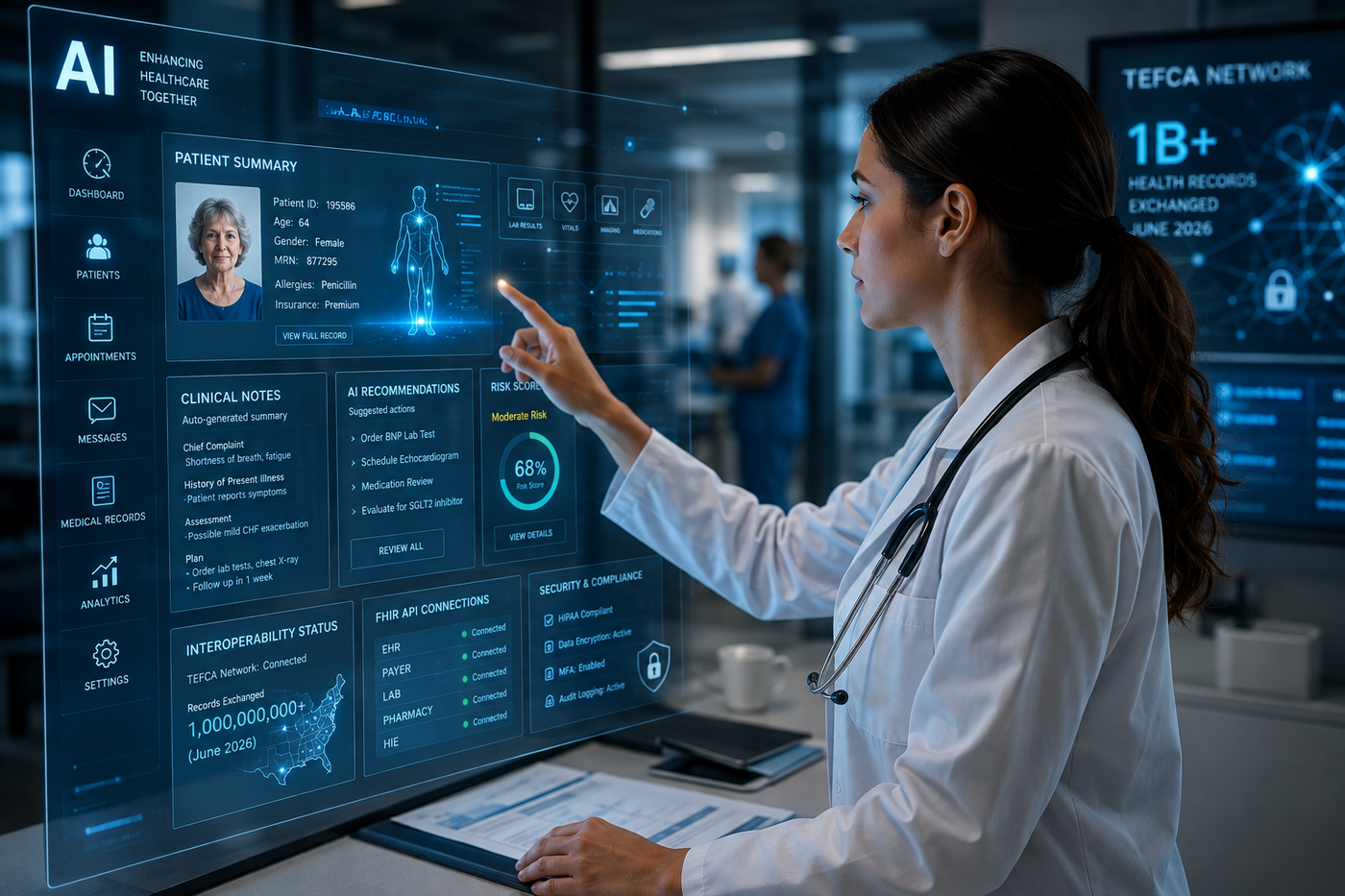
Several healthcare technology trends are converging around that challenge. AI is moving deeper into clinical and administrative workflows. FHIR APIs are becoming increasingly important to healthcare interoperability. TEFCA has moved from an emerging national framework to an exchange network that has surpassed 1 billion health records. Federal policy is encouraging greater access to electronic health information, while healthcare cybersecurity is becoming inseparable from informatics architecture. Together, these developments are redefining healthcare informatics and the skills organizations will need to compete in an increasingly connected, AI-enabled healthcare system. (ONC)
1. AI in Healthcare Is Moving Into Clinical Workflows
The first phase of generative AI adoption in healthcare was dominated by experimentation. Health systems tested large language models, evaluated potential applications and tried to understand where the technology could safely produce value. In 2026, the conversation is becoming more operational. Healthcare organizations are increasingly evaluating AI against specific workflows where administrative burden, clinician workload or process inefficiency creates a measurable clinical or business problem.
Ambient clinical documentation is among the most visible examples, but the opportunity is considerably broader. Health systems are exploring AI for coding support, clinical summarization, patient-message triage, care coordination, scheduling, revenue-cycle operations, diagnostic support and patient access. Recent deployments provide evidence that these technologies are moving into routine practice. Austin Regional Clinic, for example, reported in July that 97% of its clinicians were using an ambient AI documentation system across its 40 Central Texas locations, with physicians spending 18.5% less time on notes per appointment. The organization is also exploring broader uses involving test-result summaries, medical literature, orders and coding. (Axios)
Clinical AI is also expanding beyond administrative work. Hospitals are deploying AI to identify strokes, pulmonary embolisms, fractures and other conditions from medical imaging, while newer foundation-model approaches are being developed to evaluate multiple conditions and assist with report generation. These developments are moving healthcare AI closer to clinical decision-making, where questions of validation, oversight and accountability become considerably more consequential. (Houston Chronicle)
This is where healthcare informatics becomes central to AI implementation. The difficult question is no longer whether an algorithm can generate an accurate summary or complete a task. Health systems must determine which information an AI system can access, how its output will be validated, when human review is required, how performance and bias will be monitored, and who is accountable when an AI-supported recommendation influences patient care or business operations.
The quality of the underlying information presents another constraint. AI cannot compensate indefinitely for fragmented patient records, inconsistent terminology, duplicate identities or incomplete clinical histories. An advanced model operating on unreliable information can simply produce unreliable conclusions more efficiently. The value of AI in healthcare therefore depends heavily on the less visible work of data engineering, interoperability, clinical informatics and information governance.
This evolution also favors a different type of healthcare technology professional. Organizations increasingly need people who can work across clinical operations, EHRs, product development, data, cybersecurity and organizational change. Building or selecting an AI model may be only one part of the challenge. Integrating it safely into the way healthcare is actually delivered is where much of the value will ultimately be created.
2. Healthcare Interoperability Is Becoming an API Strategy
Interoperability has been a health IT priority for years, but its strategic importance is increasing as healthcare becomes more dependent on real-time information exchange. FHIR-based APIs are becoming part of the connective infrastructure linking electronic health records, payer systems, patient applications, health information exchanges and emerging AI platforms.
This represents an important evolution from traditional healthcare interoperability projects. Health systems have historically built individual interfaces to connect specific systems. The emerging model is more platform-oriented, with reusable APIs supported by common approaches to patient and provider identity, authorization, consent, event notifications, data provenance and data-quality management. The objective is not merely to move information between two applications, but to create an infrastructure capable of supporting a growing ecosystem of clinical, administrative and consumer technologies.
Federal policy is accelerating that transition. Under CMS's Interoperability and Prior Authorization Final Rule, impacted payers face requirements involving Provider Access, Payer-to-Payer and Prior Authorization APIs, with the principal API requirements beginning in 2027. The policy is intended to improve information exchange while reducing administrative burden associated with prior authorization.
The regulatory agenda has continued to evolve in 2026. CMS proposed in April that impacted payers incorporate coverage and documentation requirements for drugs covered under a medical benefit into their Prior Authorization APIs beginning October 1, 2027. The proposal would extend the API-driven approach to another significant area of healthcare administration and further reinforce the movement toward standards-based electronic prior authorization. (Centers for Medicare & Medicaid Services)
For health systems, payers and healthcare technology companies, the opportunity extends beyond regulatory compliance. Electronic prior authorization can affect revenue-cycle performance, staff productivity, patient access and the speed with which clinicians receive decisions. Organizations capable of connecting payer requirements with EHR workflows and clinical documentation may be able to eliminate substantial amounts of manual work.
The technical standard, however, is only the beginning. Successful implementation requires workflow redesign, API management, payer connectivity, data normalization, documentation capture and analytics capable of demonstrating whether the investment is actually reducing administrative burden. The organizations that benefit most from healthcare interoperability will not necessarily be those with the greatest number of APIs. They will be those that successfully turn connectivity into better workflows.
3. TEFCA Is Moving Health Data Liquidity Closer to Reality
The Trusted Exchange Framework and Common Agreement, or TEFCA, represents another important change in the healthcare information landscape. Its objective is to make health information exchange across networks more routine by establishing a national framework through Qualified Health Information Networks. The framework is intended to allow providers, payers, public health organizations and patients to exchange electronic health information more consistently across otherwise disconnected networks.
The scale of that exchange has increased rapidly. On June 26, 2026, HHS announced that more than 1 billion health records had been exchanged through TEFCA. The acceleration is significant: approximately 10 million documents were exchanged through TEFCA before 2025, compared with 464 million during 2025 alone, followed by the 1 billion milestone in June. The growth indicates that national health information exchange is moving beyond policy architecture and becoming meaningful operating infrastructure for the healthcare system. (ONC)
Greater connectivity, however, does not automatically produce greater clinical value. Making an external record technically available is different from making its information useful to a physician, nurse or care manager during a clinical encounter. Healthcare informatics teams still have to solve patient matching, terminology normalization, data provenance, consent, query performance and the presentation of external information within clinical workflows.
This distinction becomes increasingly important as AI enters the equation. An AI system capable of summarizing a patient's history becomes considerably more useful when it has access to a more complete longitudinal record. At the same time, incorrect patient matching, incomplete data or poorly understood provenance become more consequential when automated systems use that information to generate clinical summaries or recommendations. Data liquidity and AI adoption therefore reinforce one another while simultaneously increasing the importance of information governance.
TEFCA's long-term importance may ultimately be measured less by the volume of information exchanged than by whether healthcare organizations can make that information usable. The challenge for informatics teams is moving from data availability to data utility, ensuring that clinicians receive relevant, trusted information at the appropriate point in the workflow without creating another layer of information overload.
4. Healthcare AI Governance Is Becoming an Enterprise Responsibility
The federal health IT environment is evolving alongside these technological changes. ASTP/ONC's HTI-5 proposed rule seeks to streamline portions of the Health IT Certification Program while creating a new foundation for standards-based APIs and AI-enabled interoperability. The proposal would reduce some certification requirements, revise definitions related to electronic health information access, exchange and use, and establish a foundation for future FHIR-based API requirements. ASTP/ONC estimates that the proposed changes could generate $1.53 billion in savings, including approximately $650 million over five years for health IT developers, providers and other stakeholders. (ONC)
The direction is significant for healthcare informatics. Federal policy is encouraging more open information exchange and a technology environment increasingly built around FHIR-based APIs and AI-enabled systems. At the same time, reducing or changing certification requirements does not eliminate the operational need for responsible governance within healthcare organizations.
As AI capabilities develop faster than prescriptive regulation, health systems, purchasers and technology companies will increasingly have to establish their own standards for acceptable risk. Clinical safety, model validation, patient privacy, documentation, procurement standards, data governance and accountability cannot simply be delegated to a certification process or technology vendor.
The result is a more demanding governance environment. Healthcare organizations will need multidisciplinary structures that include clinical informatics, medical and nursing leadership, technology, cybersecurity, compliance, legal, data and finance. An AI tool that influences clinical documentation, patient communication or decision support is no longer simply an IT purchase. Its implementation can create clinical, operational, financial, legal and cybersecurity consequences across the enterprise.
Healthcare AI governance will therefore become increasingly important as organizations move beyond experimentation. Mature health systems are likely to distinguish themselves not by how quickly they purchase AI, but by how effectively they determine where it should be used, how its performance should be measured and where human accountability must remain.
5. Healthcare Cybersecurity Is Now an Informatics Requirement
The growing connectivity of healthcare creates enormous potential, but every new connection also expands the environment that must be secured. Electronic health records, cloud platforms, APIs, medical devices, payer connections, third-party applications and AI systems collectively create a digital ecosystem in which healthcare cybersecurity can no longer remain separate from informatics architecture.
HHS's healthcare-specific Cybersecurity Performance Goals reinforce this connection between technology resilience and patient safety. The framework emphasizes high-impact practices including asset inventory, vulnerability management, vendor and supplier cybersecurity requirements, network segmentation, centralized logging and incident preparedness. These priorities are particularly relevant as health systems become more dependent on cloud infrastructure, connected devices, external vendors and APIs. (HHS Cyber Gateway)
AI adds another layer of complexity. It can strengthen cybersecurity operations through threat detection, triage, documentation review and automation, but AI applications can also become new paths to sensitive systems and protected health information. An AI agent with access to an EHR, scheduling platform, patient inbox or payer portal requires an identity, defined permissions and auditable activity just as a human user does.
Consider an AI documentation application. Clinical accuracy may receive most of the attention during evaluation, but accuracy represents only one dimension of risk. A health system must also understand where recordings and transcripts are stored, what data the vendor retains, whether protected health information can be used for model training, how users and services are authenticated, what activity is logged, how third parties are managed and how the organization will operate if the service becomes unavailable. The HIPAA Security Rule continues to require administrative, physical and technical safeguards designed to protect the confidentiality, integrity and availability of electronic protected health information. (HHS.gov)
These are informatics, cybersecurity and clinical operations questions simultaneously. As healthcare becomes more connected and AI-enabled, the boundaries separating those disciplines will continue to narrow. Cybersecurity will increasingly become part of the architecture itself rather than a review conducted after a technology decision has already been made.
6. Healthcare Technology Hiring Is Shifting Toward Hybrid Talent
The commercial and workforce implications of these healthcare informatics trends are becoming clearer. The greatest opportunity may not reside solely with companies building sophisticated AI models. Significant value will be created by the organizations and professionals capable of turning those technologies into secure, interoperable and measurable healthcare workflows.
AI deployment requires clinical workflow expertise, EHR integration, governance and adoption measurement. Healthcare interoperability requires FHIR expertise, API engineering, identity management, consent, normalization and an understanding of how information is consumed inside clinical environments. Prior authorization requires knowledge of payer-provider workflows, revenue-cycle operations, clinical documentation and integration. Cyber resilience requires identity and access management, segmentation, vendor-risk management, cloud security, incident response and an understanding of medical-device environments.
Analytics presents a similar challenge. Health systems have accumulated enormous quantities of data, but possession of data does not guarantee insight. Organizations pursuing population health, value-based care, utilization management or AI-assisted clinical decision-making need reliable data models, meaningful measures and workflows that turn analysis into action.
The result is growing demand for hybrid talent. A nurse informaticist who understands clinical workflow but can also collaborate with product, data and implementation teams brings a different form of value than a purely technical specialist. An integration architect who understands FHIR and revenue-cycle operations can solve problems that extend well beyond API development. A cybersecurity leader who understands clinical operations and medical-device environments can make security decisions that protect the organization without unnecessarily disrupting patient care.
Recent HIMSS work reinforces the expanding role of nursing informatics. Its 2026 nursing informatics programming emphasizes nurses' growing influence in technology strategy, innovation, clinical workflows and system-wide transformation rather than positioning informatics solely as a technical support function. That development is consistent with the broader shift toward professionals capable of translating between technology and the realities of care delivery. (HIMSS)
The common denominator is context. Healthcare technology has become too interconnected for organizations to rely exclusively on professionals who understand only one part of the environment. Technical depth remains important, but healthcare domain knowledge, workflow understanding and the ability to work across functions are becoming increasingly valuable.
7. Healthcare AI Will Face a More Demanding ROI Test
The next stage of AI adoption will require more rigorous economic and clinical evaluation. During the experimentation phase, healthcare organizations could justify pilots as learning exercises. As deployment expands, executives, clinicians and boards will increasingly expect evidence that investments produce measurable improvements in clinical outcomes, productivity, workforce experience or financial performance.
The shift is already visible in real-world deployments. Ambient AI implementations are increasingly being discussed in terms of documentation time and clinician workload rather than simply technological capability. Austin Regional Clinic's reported 18.5% reduction in time spent on notes per appointment is an example of the type of operational measure that will increasingly matter as health systems decide whether to expand AI deployments. (Axios)
Clinical AI will face an even higher evidentiary bar. Recent reporting on hospital deployments shows meaningful improvements in specific workflows, including faster identification of certain conditions, while also highlighting continuing questions about cost and the degree to which AI improves patient outcomes. That tension is likely to define the next stage of healthcare AI adoption: operational improvements will be valuable, but technologies that influence patient care will increasingly need to demonstrate that efficiency gains translate into clinically meaningful results. (Houston Chronicle)
An ambient documentation platform should therefore be evaluated on more than the number of clinicians using it. Organizations will want to understand whether it reduces documentation time, improves note quality, affects clinician satisfaction or retention, changes coding accuracy, or creates new risks. Revenue-cycle automation will be evaluated through denial rates, processing time, labor requirements and cash performance. Patient-access technologies will be judged by scheduling efficiency, abandonment, wait times and patient experience.
Adoption is not return on investment, and a successful pilot is not necessarily a successful operating model. Healthcare organizations will become more disciplined about distinguishing technologies that demonstrate measurable value from those that simply add another application to an already crowded technology portfolio.
8. Healthcare Technology Point Solutions Will Face Greater Scrutiny
Healthcare's enthusiasm for innovation has produced an enormous ecosystem of specialized applications. AI could intensify that proliferation unless buyers become more selective. Health systems already manage complex technology environments, and each additional product can introduce another integration, identity, data, procurement, security and support requirement.
As a result, buyers are likely to place greater value on healthcare technology solutions that integrate naturally with existing EHR, identity, analytics and workflow environments. A powerful AI application that requires clinicians to leave their primary workflow, creates a separate data repository or introduces substantial cybersecurity complexity may struggle against a somewhat less sophisticated solution that fits the organization's existing architecture.
This does not mean innovation will consolidate entirely into large platforms. Specialized health technology companies can still create substantial value, particularly when they solve clearly defined clinical or operational problems. The standard for adoption, however, will increasingly include interoperability, implementation complexity, data governance and cybersecurity alongside product functionality.
For technology companies selling into healthcare, integration strategy is becoming part of product strategy. Buyers increasingly need to understand not simply what a product can do, but how it will coexist with the systems, workflows and security architecture already operating within the organization.
9. Cybersecurity Will Become a Healthcare Technology Buying Gate
Security reviews have long been part of healthcare technology procurement, but the growing sensitivity of AI and data platforms will make cybersecurity an increasingly important determinant of whether a technology purchase progresses.
Health systems will need greater visibility into vendor data practices, deployment architecture, identity controls, auditability, incident-response capabilities and third-party dependencies. AI creates additional questions about model training, data retention, inference environments and the degree of autonomy granted to applications and agents. Those concerns become more significant as AI moves from generating information for human review toward systems capable of initiating or coordinating actions across clinical and administrative environments.
This changes the commercial process. A healthcare technology may demonstrate compelling functionality and still fail to reach production because the organization cannot become comfortable with its security or data architecture. Vendors that treat cybersecurity documentation and architecture as an afterthought may discover that the problem surfaces late in the sales process, after considerable time and resources have already been invested.
Cybersecurity therefore becomes more than a technical requirement. It becomes a competitive capability for healthcare technology companies and an essential component of healthcare informatics strategy for providers.
What Healthcare Informatics Leaders Should Watch Next
Several developments will help determine how quickly this new healthcare informatics model matures. The first is whether AI investments begin producing measurable returns. Organizations will increasingly examine documentation time, administrative labor, denial reduction, clinician retention, patient access, clinical outcomes, quality and safety rather than relying primarily on adoption statistics. The transition from pilot programs to enterprise deployment will depend heavily on whether those investments can demonstrate sustained clinical or financial value.
FHIR implementation and electronic prior authorization will provide another important test. CMS has established a clear direction toward API-enabled exchange, and its 2026 proposal to extend FHIR-based prior authorization requirements to medical-benefit drugs shows that the policy agenda is continuing to expand. Technical compliance alone, however, will not determine success. The more difficult work will involve integrating those capabilities into existing clinical and administrative workflows while accommodating variation across payers and health systems. (Centers for Medicare & Medicaid Services)
AI governance will also become more formal. As artificial intelligence moves deeper into clinical and operational systems, responsibility cannot reside solely within an innovation team or IT department. Mature organizations will increasingly need cross-functional governance involving clinical leaders, informatics, compliance, legal, cybersecurity, data, technology and finance.
Technology portfolio consolidation deserves similar attention. Health systems will continue evaluating innovative applications, but economic pressure and architectural complexity will make it harder to justify disconnected point solutions. Technologies that fit naturally into EHR, identity, analytics and workflow ecosystems will have an advantage over products that require clinicians and administrators to manage another isolated application.
Finally, cybersecurity will continue moving closer to the center of health IT strategy. More health data exchange, more APIs and more autonomous technology create greater dependency on identity, access management, vendor controls, monitoring and resilience. The organizations that successfully modernize will be those that treat security as part of healthcare informatics architecture rather than a review performed after the architecture has already been designed.
Healthcare Informatics Is Becoming the Integration Discipline
The most important healthcare informatics trend in 2026 may be the expansion of the field's mandate. Informatics is moving beyond the digitization and management of clinical information toward the integration of data, workflows, artificial intelligence, interoperability, cybersecurity and clinical decision-making. The rapid expansion of TEFCA, continued federal movement toward FHIR-based exchange, wider deployment of AI in clinical workflows and greater emphasis on healthcare cybersecurity all point in the same direction: the digital components of healthcare are becoming more interconnected. (ONC)
That evolution creates both an opportunity and a constraint. Healthcare organizations now have access to technologies capable of reducing administrative burden, improving health information exchange and augmenting human decision-making at a scale that would have been difficult to imagine a decade ago. Yet those technologies will produce little sustainable value if the data feeding them are unreliable, if they cannot operate within clinical workflows, if clinicians do not trust them, or if their deployment creates unacceptable privacy and cybersecurity risks.
The next competitive advantage in healthcare technology is therefore unlikely to come from AI alone. It will come from the ability to connect technology to the operating reality of healthcare. That requires trusted data, interoperable systems, disciplined AI governance, secure architecture and professionals who understand how those elements interact and ultimately affect patient care.
Healthcare informatics is becoming the discipline that brings those pieces together. As healthcare becomes increasingly connected and AI-enabled, that role will become more consequential, not less. The organizations that succeed will be those that stop treating AI, interoperability, cybersecurity and clinical workflow as separate technology initiatives and begin managing them as interconnected components of a modern healthcare operating environment.
